
20 years of pioneer in xinjiang tourism for overseas travelers
Born Here, Know Best, Your Journey's Blessed
No Shopping. No Detour, 99% Excellent Review

contact UsOn Wechat
With a sizeable population of 730,000, the Hui people mainly live in the area of Changji Hui Autonomous Prefecture, such as Changji City, Miquan, Yining City, Huocheng City and Urumqi, Yanji Hui Autonomous County, Turpan County and Shanshan County and Tuokexun County. The history of the Hui people can be traced back to the northwest Hui-he people (the Ouigurs) in the Tang and Song Dynasties. Because living with Han people and other minorities for quite long time, their costumes are almost the same style as the local people. In the Hui communities, men over mid-age wear small white hats, white cotton shirts and black shawls while women put on white or blue caps. The old women like wearing black cotton-padded jackets with stringed bottoms of trousers legs.
The Hui people believe in Islamism. They are characterized by observing tradition and convention. They do not touch pork. Whenever Hui people meet, they will greet each other with respect. When a visitor comes, a cup of tea will be served first, and then fruits and deserts or home-made desert followed. Moreover, all the family members have to greet the guest. If the guest happens to be an old person, they will invite him/her to sit on a warm brick-built bed with a cup of tea. When the guest takes leave, all the family members start off to see him/her off. If he/she is a guest from a far distance or a distinguished visitor, the whole family will take him/her out of the village or town. All the festivals of Hui are closely connected with Islamism, in which Fast-Breaking or Eid-ul-Fitr and the Corban Festival are the most important ones.
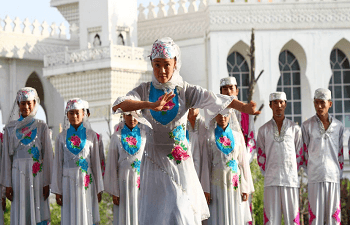
The Hui people use the Chinese language in speaking and writing. They keep some Arabian and Persian fragments in their spoken language. The Hui people generally inhabit in a scattering way in China but some of them or certain groups live in the same communities.
Hui people are hard workers and adaptable to new surrounding. They are engaged in framing and breeding domestic animals at the same time in rural areas. They are involved in catering industry, handicraft industry, fur-processed industry, business and trade. Fried cake, fried rolling noodles(sanzi), mutton, bean jelly, starch-square and mutton soup, cooked chopped entrails of sheep or cows are traditional food of the Hui people in Xinjiang. What's more, the pattern serving the “nine dishes that are put in three lines on table” is a must in the formal banquet.
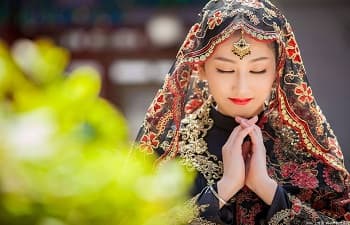
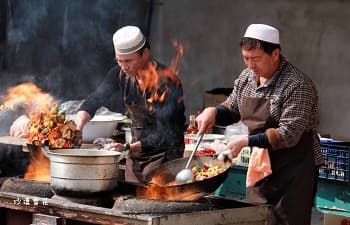
With a sizeable population of 730,000, the Hui people mainly live in the area of Changji Hui Autonomous Prefecture, such as Changji City, Miquan, Yining City, Huocheng City and Urumqi, Yanji Hui Autonomous County, Turpan County and Shanshan County and Tuokexun County. The history of the Hui people can be traced back to the northwest Hui-he people (the Ouigurs) in the Tang and Song Dynasties. Because living with Han people and other minorities for quite long time, their costumes are almost the same style as the local people. In the Hui communities, men over mid-age wear small white hats, white cotton shirts and black shawls while women put on white or blue caps. The old women like wearing black cotton-padded jackets with stringed bottoms of trousers legs.
The Hui people believe in Islamism. They are characterized by observing tradition and convention. They do not touch pork. Whenever Hui people meet, they will greet each other with respect. When a visitor comes, a cup of tea will be served first, and then fruits and deserts or home-made desert followed. Moreover, all the family members have to greet the guest. If the guest happens to be an old person, they will invite him/her to sit on a warm brick-built bed with a cup of tea. When the guest takes leave, all the family members start off to see him/her off. If he/she is a guest from a far distance or a distinguished visitor, the whole family will take him/her out of the village or town. All the festivals of Hui are closely connected with Islamism, in which Fast-Breaking or Eid-ul-Fitr and the Corban Festival are the most important ones.
The Hui people use the Chinese language in speaking and writing. They keep some Arabian and Persian fragments in their spoken language. The Hui people generally inhabit in a scattering way in China but some of them or certain groups live in the same communities.
Hui people are hard workers and adaptable to new surrounding. They are engaged in framing and breeding domestic animals at the same time in rural areas. They are involved in catering industry, handicraft industry, fur-processed industry, business and trade. Fried cake, fried rolling noodles(sanzi), mutton, bean jelly, starch-square and mutton soup, cooked chopped entrails of sheep or cows are traditional food of the Hui people in Xinjiang. What's more, the pattern serving the “nine dishes that are put in three lines on table” is a must in the formal banquet.

